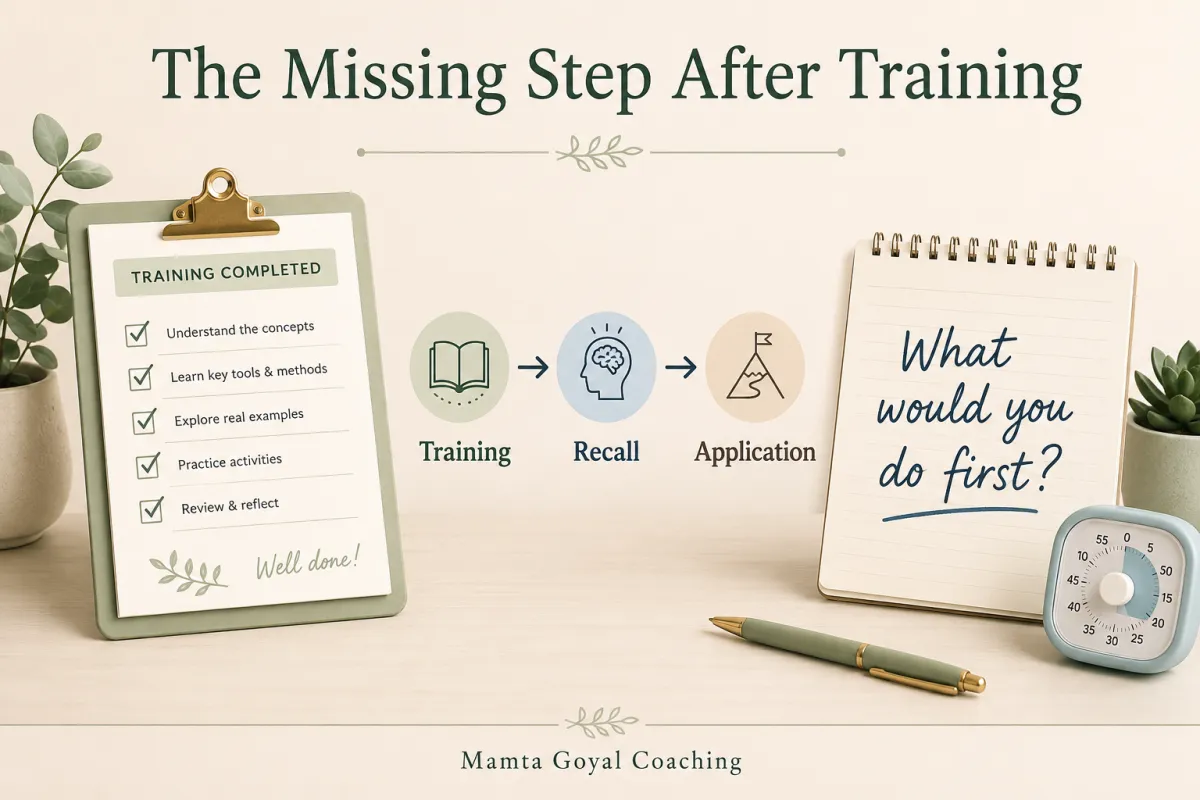
Why Training Doesn’t Stick: The Missing Step Between Understanding and Doing
Why Training Doesn’t Stick: The Missing Step Between Understanding and Doing
Why teams go back to old habits when the work gets urgent
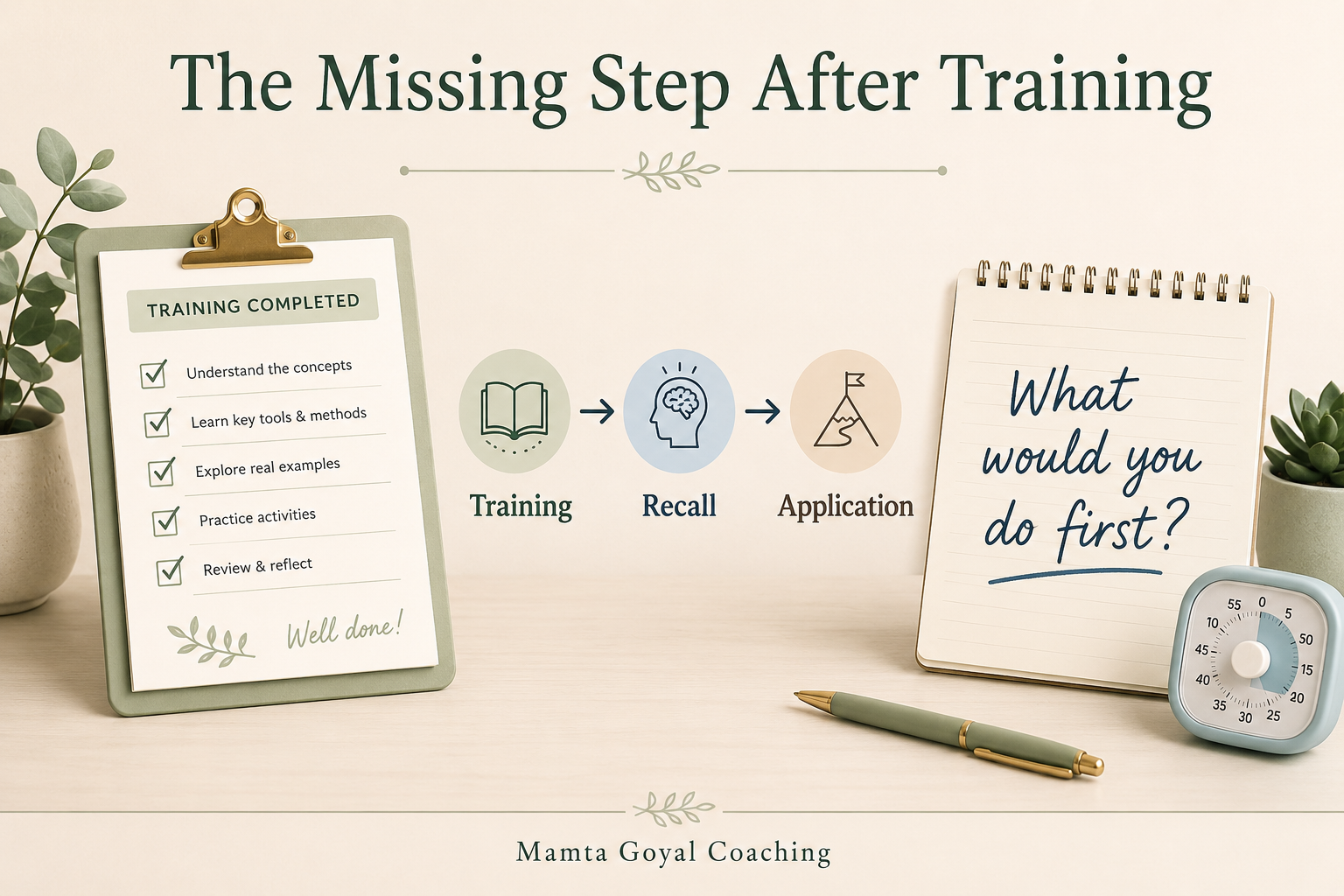
Most training fails quietly.
People attend the session. They understand the material. They may even agree that it was useful. The course is marked complete, the document is shared, and everyone moves on.
Then the real situation shows up.
A customer issue gets urgent, and people go back to the person they always call. A release process is explained, but the team still uses the old shortcut. A feature flag is added because it feels safer, but no one creates the cleanup plan. A new tool is introduced, but the work continues in the same old pattern with a slightly different screen.
This is when managers often ask, “Why didn’t they follow the training?”
I think the better question is, “Did the training help them recall what to do when the moment came to actually use it?”
That question changes the focus. Completion is easy to track. Application is harder to see. Recall sits in the middle. If people cannot recall the right first move when the situation appears, the training has not fully transferred into work.
Why Training Completion Does Not Mean Learning Transfer
In many organizations, training is treated as an event. Attend the session. Watch the demo. Read the material. Complete the course. Check the box.
That gives us evidence of exposure. It does not always give us evidence of use.
There is nothing wrong with explaining a process clearly. People need the steps, definitions, examples, and expectations. The problem begins when we assume that understanding something in a calm setting means people will remember and use it later in a messy setting.
I have seen this gap in onboarding, compliance training, software release processes, incident management, quality procedures, and tool adoption. People are not always ignoring the training. Many times, they understood it at the time, but the training did not help them recall the right action later.
That first action matters. In software teams, the first action often shapes everything that follows. Who gets called? Which channel gets used? Is the issue documented? Is the right owner involved? Is the risk visible early enough? Is the workaround becoming permanent?
Training should help people make that first move better.
Why Old Habits Beat New Training Under Pressure
Old habits are not weak. They are efficient.
When work gets urgent, people rarely pause and think, “Let me retrieve the training from last month.” They reach for the path that feels familiar, fast, and safe.
That path may be a trusted person. It may be an old spreadsheet. It may be a shortcut in the tool. It may be the senior engineer who “always knows.” It may be a feature flag because feature flags have worked before.
This is the part we sometimes miss in process improvement: the new process is not only competing with ignorance. It is competing with a working habit.
That habit may not be ideal, but it has history. It has saved the team before. It has emotional safety. So when pressure rises, people return to it.
For example, an incident escalation process may be correct on paper. It may define severity, owners, timelines, and communication channels. Everyone may understand it during training. But if the team still believes the fastest path is to call one trusted engineer, that informal path will win during urgency.
The same pattern can happen with feature flags. The training may explain when to use them and why cleanup matters. But when a change feels risky, people may flag almost everything because it feels safer. Later, the cleanup plan is forgotten and the safety mechanism becomes operational debt.
That does not make the team careless. It tells us the training did not help people recall and use the process when the moment got messy.
Recall Practice Helps Training Stick
I was listening to Andrew Huberman’s episode on studying and learning. One useful idea was active recall: instead of only rereading or highlighting, step away from the material and try to recall it from memory. Huberman Lab describes active recall as a method that can improve retention by asking people to retrieve specific elements from memory.
The same idea appears in learning research. Roediger and Karpicke’s work on test-enhanced learning found that taking memory tests can improve later retention, not only measure what someone knows. In other words, retrieval is not just an assessment tool. It can be part of learning itself.
At work, I would not call this a test. The word “test” can make people defensive, and it can make the exercise feel like school.
I would call it an application check.
Not a quiz full of definitions. Not a compliance question. Not a “gotcha.” A short realistic scenario that asks people to retrieve the training and use it.
The simplest version is this: at the end of important training, ask people to think of a real scenario at work, apply what they learned, and write down what they would do first.
That can take five minutes.
The value is not in making the training longer. The value is in moving people from “I understood it” to “I can use it.”
A Five-Minute Application Check for Better Training Transfer
A good application check should be close to the real work. It should match the audience and the kind of decision they will actually need to make.
For incident escalation training, the scenario may be:
A customer issue is getting worse late in the day. The person you usually call is unavailable. The team is unsure whether this is a product defect, configuration issue, or data problem. What do you do first?
For feature flag training, the scenario may be:
A change affects one customer segment. The team wants safety, but the change may also be handled by configuration or staged rollout. Do you need a feature flag? If yes, who owns cleanup and by when?
These are not complicated questions. They are useful because they ask people to retrieve and apply the learning before the pressure arrives.
Recognition sounds like, “Yes, I understand the process.”
Recall sounds like, “Here is what I would do first.”
Application sounds like, “Here is what I would do first in this specific situation, with these constraints.”
That is the shift managers should care about.
As a bonus, these short scenarios may also show where the training itself is unclear. But the main purpose is still learning transfer: helping people remember and use what they learned when the work requires it.
Stop Ending Training with Only “Any Questions?”
Many trainings end with, “Any questions?”
That question is not wrong, but it is not enough. People often do not know what they do not know until they try to use the concept.
A better ending is a realistic application question.
For process training, ask, “What would you do first in this situation?”
For tool training, ask, “Where would this fit in your actual workflow?”
For incident training, ask, “Who needs to know first, and where should it be recorded?”
For release training, ask, “What decision would stop this release?”
For feature flag training, ask, “What is the cleanup plan?”
These questions change the signal you get from training. You are no longer only checking whether people heard the content. You are checking whether they can reach for it.
When a process breaks down later, the common response is to retrain people. Sometimes that is necessary. But often, the answer is not more training. The answer is better transfer.
Can people use the learning in the place where it matters?
That is the real test.
Training gives people information. Recall practice helps them retrieve it. Application checks help them connect it to their work.
To me, that is practical process improvement. Not a big program. Not a new system. Not another training module. Just a better ending to the training you already planned.
Ask people to think of a real scenario at work, apply what they learned, and write down what they would do first.
Learning sticks when people retrieve it and apply it close to the real work.
Maybe the next process improvement is a five-minute application check.
Sources
Huberman Lab - Memory and Learning / Optimal Protocols for Studying & Learning.
Roediger & Karpicke - Test-Enhanced Learning: Taking Memory Tests Improves Long-Term Retention.