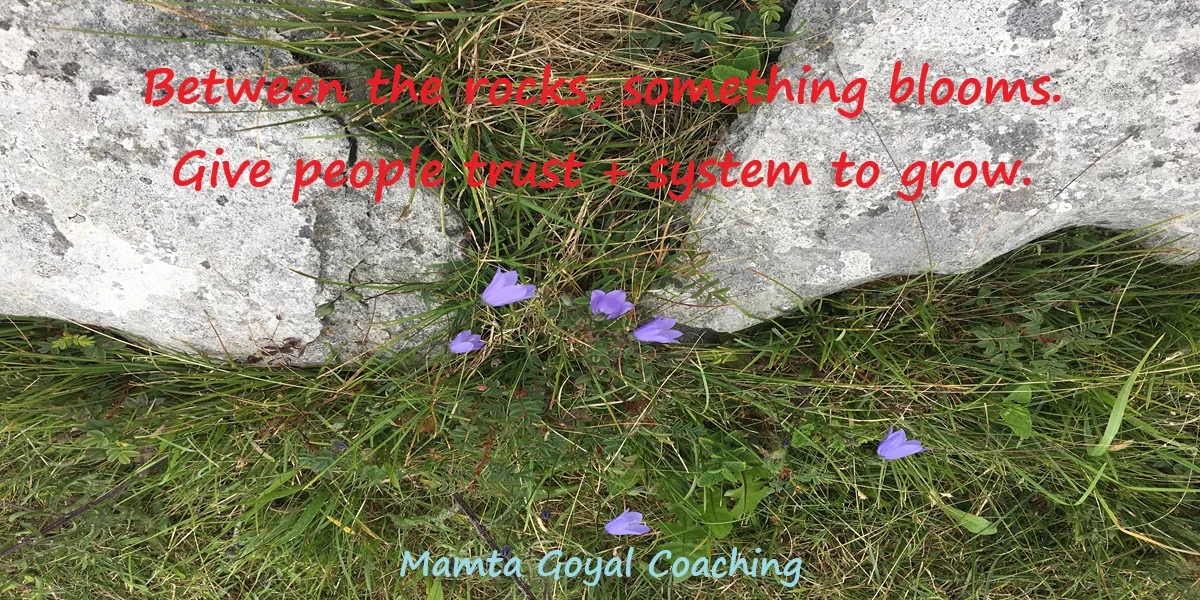
Wildflowers Grow in Unlikely Places And So Do People
Wildflowers Grow in Unlikely Places And So Do People

Wildflowers don’t wait for perfect soil. They use the patch they have. People can do that, too—when two conditions exist: trust and clear structure.
A Compliance Quality Engineer I coached took ownership of a single Jira board. With the right guidance and autonomy, they became our go-to admin—and soon outpaced me.
A teacher with no budget built a recyclables “lab” in a portable; students returned at lunch because curiosity had a home.
An understaffed nurse started each shift with one prompt—“What will make tonight safer?”—and near-misses went down.
A sales rep in a “no-growth” territory ran tiny living-room meetups; warm referrals followed.
Different fields, same pattern: give people enough light (trust) and a simple trellis (structure), and performance appears.
The Core Idea
Trust = It’s safe to ask questions, try small changes, and surface problems.
Structure = Here’s how we work: one visible system, short cycles, simple rules.
You don’t need a big program. You need a small plot where good work can take root and spread.
What Trust Looks Like (Signals You Can Send Today)
Say the quiet part. “We’ll try small changes; if it doesn’t work, we’ll adjust—not blame.”
Normalize questions. “If you’re stuck, ask in the open. That’s part of the job.”
Give ownership. “You own this board/class corner/huddle/meetup for two weeks.”
Model learning. Share one thing you misunderstood and what you changed.
What Structure Looks Like (Minimal Trellis)
One visible system: a board, whiteboard, or shared doc—kept current.
Short loop: try → observe → adjust → share (weekly is fine).
Small scope: one workflow, one corner, one shift huddle, one meetup.
One metric: pick a single indicator that matters (stuck items, returning students, near-misses, warm referrals).
Mini-Cases (How the Trellis Helped)
Tech (Jira)
Start small—one board, one workflow. Add a weekly 30-minute “improve the system” slot. Track “items stuck in progress > 5 days.” Invite the beginner to propose changes.
Outcome: cleaner schemas, fewer stuck tickets—and a new expert grows.
Education
Set up a cardboard-and-recyclables station. Post a simple template: hypothesis → setup → observation → next time. Track “students who return at lunch.”
Outcome: curiosity becomes a habit.
Healthcare
Open each shift: “What will make tonight safer?” Close with ten minutes to log one change. Track near-misses.
Outcome: fewer close calls, calmer nights.
Sales
Host 6–8 person meetups. Ask each attendee for one introduction. Track warm referrals per week.
Outcome: a working network where the “dead” region used to be.
The 60–90 Minute Starter Playbook
Name your patch. Choose one area where you can see results in 2–4 weeks.
Make work visible. Create the board/whiteboard/shared doc. Keep it live.
Pick one metric. Decide what “better” means right now.
Set sunlight rules. Post three lines: We try small. We share learning, not blame. We change one thing next cycle.
Run two cycles. Protect the time. No new scope mid-cycle.
Share what changed. One paragraph or two bullets is enough.
Simple Templates You Can Copy
Weekly Cycle Note
What we tried:
What we saw:
One change for next week:
Basic Board Columns
Backlog → Doing → Review → Done → “Needs Fix” (optional)
Shift Huddle Prompt
Tonight’s top risk:
One adjustment we’ll make:
Who’s owning the follow-up:
Micro-Meetup Agenda (45 minutes)
10 min: Intros
20 min: One practical topic (demo, case, Q&A)
10 min: Ask for one intro each
5 min: Next date + recap
How to Choose the One Metric
Pick something your team will feel each week:
Friction down: stuck items, handoffs, “where does this go?” pings
Speed up: cycle time from idea → test → tweak
Safety up: near-misses, incidents, rework
Energy up: repeat student visits, meetup return rate, inbound referrals
If you’re torn, start with stuck items or near-misses. Both show signal fast.
Common Pushbacks (Plain Replies)
“We don’t have budget.” → Visibility + short loops are free.
“We need a full strategy first.” → Build one plot where strategy touches the ground.
“People aren’t motivated.” → Lower confusion and risk; energy follows.
Pitfalls to Avoid
Fancy boards nobody updates.
Too many “priorities.”
Endless retros with no change.
Leaders who never show their own learning.
A 30-Day Plan
Week 1: Set the plot (area + metric + sunlight rules).
Week 2: Cycle 1 (try one change; write a short note).
Week 3: Cycle 2 (iterate; write a short note).
Week 4: Share the story (before → two changes → after; decide keep/expand/retire).
Why the Wildflower Analogy Works
Wildflowers don’t demand ideal soil. They create better soil—roots loosen ground, leaves add shade, blooms attract pollinators. Teams do the same: small wins reduce friction, visible systems lower risk, stories attract help. Two cycles in, conditions improve—and keep improving.
I’m an author, coach, and a consultant now, but that Jira story keeps reminding me: capability is common; conditions are rare. Provide trust and simple structure, and people don’t just cope—they build.
Call to action: Pick one small plot this week. Give it light and a trellis. See what takes root.