The hidden reason great innovations don’t scale (and what managers can do about it)
The hidden reason great innovations don’t scale (and what managers can do about it)
A brilliant prototype can win awards… and still die quietly in “pilot purgatory.”
Not because it wasn’t innovative.
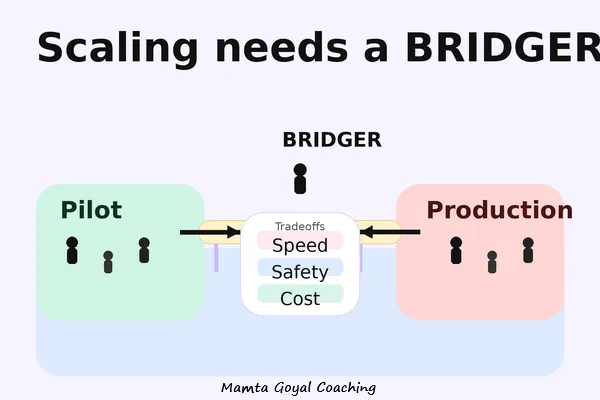
Because the leap from cutting-edge prototype → real-world production is less about invention—and more about collaboration under pressure.
That’s the core idea from the March–April 2026 Harvard Business Review article by Linda A. Hill, Emily Tedards, and Jason Wild: scaling innovation requires collaboration across groups that often have diverging priorities, capabilities, and constraints.
If you’ve ever wondered why “great ideas” stall after the demo, here’s the uncomfortable answer:
The prototype is usually not the hard part.
The hard part is getting multiple teams—each protecting something different—to commit to a shared path forward.
Why this matters: failure is common, and scaling is where it shows up
Let’s ground this in reality with a few modern signals:
By some estimates, more than 80% of AI projects fail—and RAND notes that’s twice the failure rate of non-AI IT projects.
This is the most current and relevant “prototype-to-production” example we have today: many teams can build a model or pilot, but fewer can integrate it into workflows, governance, and operations.Gartner found only 48% of digital initiatives meet or exceed business outcome targets (from a large global survey of CIOs/tech executives and non-IT executives).
Translation: even when the “project” launches, business impact isn’t guaranteed.BCG reports more than two-thirds of large-scale tech programs are not expected to be delivered on time, within budget, or within defined scope.
Translation: the bigger the scale, the more coordination debt shows up.McKinsey points to a long-standing pattern: roughly 70% of transformations fail (often due to execution pitfalls, not a lack of ideas).
These aren’t just “project management” problems. They’re symptoms of the same scaling issue:
organizations struggle to align people, systems, and incentives across boundaries.
The real problem: prototype and production live in different worlds
A prototype is built to prove possibility.
Production is built to survive reality:
reliability and uptime
security and access control
compliance and auditability
incident workflows and on-call support
performance at real load
customer expectations
long-term maintainability
So when a prototype team hears:
“How will this work with compliance and uptime?”
They sometimes translate it as:
“They’re blocking innovation.”
And when production hears:
“We can iterate quickly; let’s just ship it.”
They translate it as:
“They’re ignoring reality.”
That tension is normal. What’s missing is not talent. It’s a bridging capability.
Hill, Tedards, and Wild explain that scaling requires collaboration even when groups have different priorities, different capabilities, and different constraints.
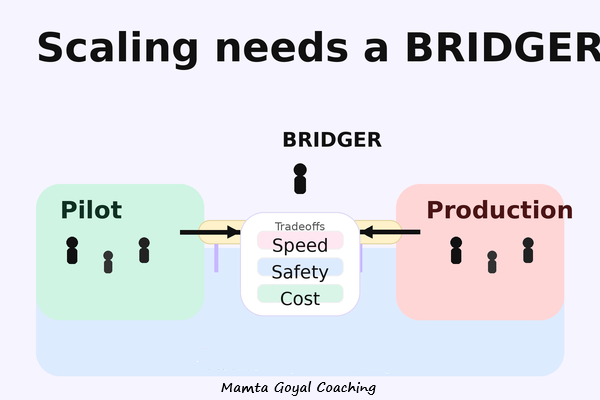
And that is exactly why organizations need bridgers.
“Bridgers” are the missing leadership muscle
The article describes “bridgers” as leaders who can help innovation scale because they have the emotional and contextual intelligence to keep collaboration working when it gets hard.
In plain words: bridgers help teams move from “cool pilot” to “real system” by doing the work that no single function owns.
What bridgers do (the practical version)
1. They embed people across groups
Not “handoffs.” Not “throw it over the wall.”
They put the right people in the same room (or the same sprint rituals) long enough to build shared understanding.
2. They build mutual trust early
So hard truths can show up in week 2, not month 8.
Trust is what allows someone to say:
“This is impressive—and here’s what will break in production,” without it becoming a fight.
3. They create commitment, not just agreement
Because scaling requires tradeoffs, not consensus.
Bridgers help partners choose a path forward even when it’s uncomfortable.
And here’s the subtle part: bridgers persuade by understanding not just what people say, but what they value, fear, and are motivated by.
That’s not “soft skill.”
That’s how adoption happens.
Why the RAND “80% AI failure” stat matters so much here
RAND’s insight is powerful because it highlights something many leaders miss:
If 80%+ of AI projects fail (by some estimates), it’s not because teams can’t build models.
It’s because AI projects collide with:
messy data realities
unclear ownership
governance and risk controls
workflow integration
adoption and training
operational support needs
That is the same prototype-to-production collision—just in modern clothing.
So if you want a contemporary example of “innovation doesn’t scale,” you don’t even need a dramatic consumer-product flop.
You can point to the most current innovation wave of all: AI.
The lesson is the same: scale is collaboration + integration + commitment.
A manager-friendly framework: The Scaling Friction Map
Next time you’re trying to scale an idea, map the friction before it becomes conflict.
Step 1: Name the groups involved
Prototype team, production/ops, security, compliance, support, finance, customer success—whoever has to live with this once it’s real.
Step 2: Ask the 3 friction questions (for each group)
Priorities: What are they optimizing for?
(speed, safety, cost, customer impact, reputation)Constraints: What do they have to protect?
(regulatory, reliability, security, support burden)Capabilities: What can they realistically execute today?
(tools, skills, staffing, maturity)
Hill, Tedards, and Wild’s point is that these differences are normal—what matters is whether someone helps teams collaborate through them.
Step 3: Assign a “bridger” (on purpose)
Not a “status meeting owner.”
A real bridger: someone trusted enough to translate both sides and strong enough to hold the tension without turning it into politics.
Why bridgers often go unrecognized (and why that’s dangerous)
Here’s the leadership irony: when bridgers do their job well, their work can look invisible because they make their partners the heroes.
The product team gets credit for the feature.
Ops gets credit for stability.
Security gets credit for controls.
The bridger gets… silence.
Which means the organization doesn’t intentionally develop more of them.
And then leaders wonder why scaling problems repeat.
What organizations should do: build and protect bridgers
If your company wants more innovation to reach production (and stay there), you can’t rely on luck.
You need to develop bridgers systematically.
Give bridgers:
diverse opportunities across functions (so they learn multiple worlds)
air cover when tradeoffs get tense (so they can do the hard conversations)
exposure to how decisions actually get made (not just how org charts say they’re made)
coaching and support (because influence is a craft)
This is how you turn “one heroic scale-up” into a repeatable capability.
And it directly addresses the patterns behind the stats:
the AI failure gap highlighted by RAND
the business outcome gap from Gartner
the delivery gap at large scale from BCG
the transformation failure patterns highlighted by McKinsey
Different domains. Same underlying issue: scaling requires cross-boundary alignment.
A simple “Bridger Checklist” (copy/paste for your next project)
When an initiative is stuck, ask:
Where is the handoff breaking down—prototype, production, or adoption?
Which group is carrying hidden risk? (support, compliance, brand, security)
What value is each side protecting?
What fear is underneath the resistance?
Who can translate both sides without needing the credit?
If you can answer those five, you’re already doing bridger work.
Closing thought
Innovation is not just invention.
It’s integration.
If your organization keeps producing great prototypes but weak outcomes, don’t blame creativity—and don’t blame operations.
Look for the missing capability in the middle:
Bridgers.
References
Hill, L. A., Tedards, E., & Wild, J. (2026). Why Great Innovations Fail to Scale. Harvard Business Review (March–April issue).
Ryseff, J., De Bruhl, B. F., & Newberry, S. J. (2024). The Root Causes of Failure for Artificial Intelligence Projects and How They Can Succeed: Avoiding the Anti-Patterns of AI. RAND Corporation (RR-A2680-1).
Gartner (2024, Nov 6). Only 48% of digital initiatives meet or exceed business outcome targets (press release).
Boston Consulting Group (2024, Nov 13). Most Large-Scale Tech Programs Fail—Here’s How to Succeed.
McKinsey & Company (2022, Mar 29; 2021, Dec 7). Transformation research and insights on failure rates and persistence of ~30% success rate.