The Dishwasher Question: A Tiny Miscommunication With a Big Lesson
The Dishwasher Question
A Tiny Miscommunication With a Big Lesson
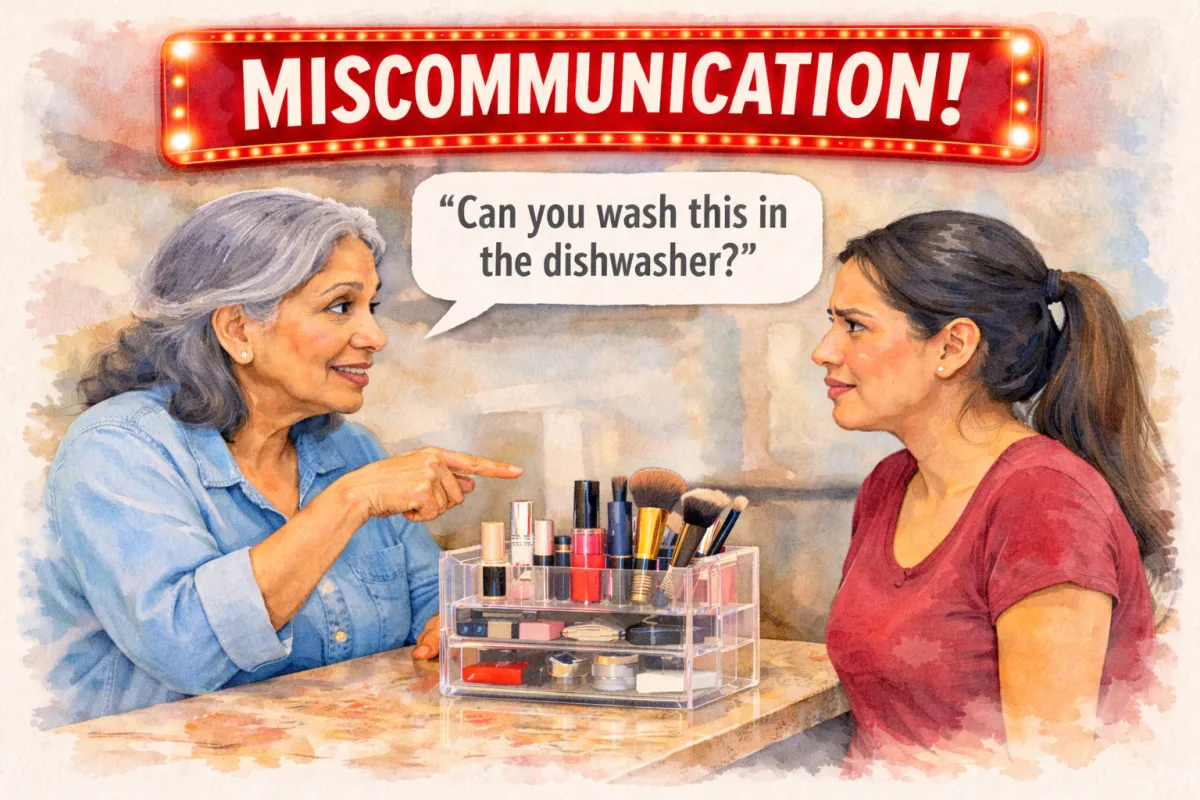
“Can you wash this in the dishwasher?”, I asked last week.
She answered “sure,” but her face looked… off. Not angry. Not confused exactly. Just a quick, strange pause.
I noticed it. And then I ignored it.
I walked away and kept doing what I was doing until, a few seconds later, I understood the look.
She thought I was telling her to wash it. Not asking whether the item could handle a dishwasher cycle…
but asking her to do the cleaning.
So I went back and clarified: “I meant, do you think this item can survive being washed in the dishwasher? That’s what I meant. I did not mean for you to wash it.”
Her face cleared instantly. She said, “Oh! I was confused why you were asking me to clean that.”
Then we both laughed. It was a tiny moment. Funny. No harm done.

And also… a perfect example of something that happens constantly.
Miscommunication isn’t rare. It’s not a special event. It’s the background noise of daily life.
And for managers, it becomes one of the most expensive background problems you’ll ever inherit.
Why miscommunication is so common
Most people think communication is about being “clear.” But clarity isn’t only about the words you choose.
It’s also about:
what the listener assumes
what they’ve experienced before
what they’re stressed about
what they think you meant
what they believe you’re asking them to do
In my dishwasher moment, the confusion wasn’t in the grammar.
It was in the implied meaning.
“Can you wash this in the dishwasher?” can mean at least two things:
Can this object go in the dishwasher without damage?
Would you please wash this for me?
Both are valid interpretations. Which one lands depends on context.
And context is personal.
That’s why two people can hear the exact same sentence—and walk away with two different action plans.
The cost of miscommunication at work is not “soft”
At home, we laugh and move on.
At work, miscommunication becomes:
rework
missed deadlines
duplicated efforts
broken trust
quiet resentment
unnecessary meetings
slow decisions
quality defects that show up later
And the money loss is very real.
Project Management Institute reports that ineffective communication puts $75 million at risk for every $1 billion spent on projects.
Grammarly reports miscommunication costs U.S. businesses ~$1.2 trillion every year, and their earlier reporting cited $12,506 per employee per year in waste tied to miscommunication.
So if you’re a manager thinking:
“Communication feels vague. I want to focus on execution.”
Communication is execution.
When your words are unclear, your execution becomes expensive.
Why new managers get hit hardest
As an individual contributor, your work is often bounded.
You write the code. You complete the analysis. You deliver your piece.
As a manager, your output becomes:
decisions
alignment
expectations
clarity
follow-through
If your team misunderstands your intent, your output becomes noise.
And here’s the part nobody tells new managers:
Most miscommunication doesn’t look like conflict.
It looks like:
“Oh, I thought you meant…”
“I assumed that was already decided…”
“I didn’t know that was urgent…”
“Wait, are we asking for feedback or approval?”
“I did what you asked… but not what you wanted.”
It’s polite. It’s normal. And it quietly breaks operational efficiency.
The “Dishwasher Pattern” at work
Let’s translate my home example into three common workplace versions.
1) The “Can you…” request that sounds like a task assignment
Manager: “Can you take a look at this?”
Team member hears: “Please do this now.”
Manager meant: “Quick opinion: should we do this?”
2) The question that sounds like criticism
Manager: “Why did you choose this approach?”
Team member hears: “You made a bad choice.”
Manager meant: “I want to understand the tradeoffs.”
3) The update that sounds like a decision
Manager: “We might ship on Friday.”
Team hears: “It’s shipping Friday.”
Manager meant: “Friday is possible if X and Y happen.”
Same words. Different meaning.
The leadership lesson
The lesson isn’t “choose better words.”
The lesson is:
Your job is not to speak.
Your job is to create shared meaning.
That’s what leadership communication really is.
And that’s why I run small experiential workshops where people practice communication clarity, so fewer misunderstandings happen, and people find their own words that fit their personality, role, and team culture. Without practice, we fall back into old habits.
A question for you
What’s your funniest miscommunication story: at home or at work? 😄
Drop it in the comments. I’m collecting these because they’re small, relatable, and they teach real leadership skills.