Stop Managing Time. Start Buying Back Capacity.
Stop Managing Time. Start Buying Back Capacity.
A pattern has been showing up in my manager success strategy sessions.
Different people. Different roles. Same sentence:
“I don’t have time. I’m overwhelmed.”
They usually say it with a tired laugh. The kind that means, “I’m doing my best, but I can’t see a way out.”
And to be clear: they’re not lazy. They’re not careless. They’re carrying too much.
Most advice responds with the same solution:
plan better
use a calendar
time block
wake up earlier
stop scrolling
be more disciplined
Those tools can help. I teach them too.
But here’s what I’ve learned after years of leading teams and coaching managers:
Overwhelm is often not a time problem. It can be a capacity problem.
Capacity includes time but also:
energy
attention
emotional bandwidth
decision-making ability
and the number of open loops your brain is holding
That’s why sometimes you “manage your time perfectly” and still feel crushed.
So, I use a different starting point.
The move that helps faster: reframe the problem
Instead of “How do I get all this done?” ask:
“Where do I have options and which option buys back capacity?”
This is the part many people skip. They assume the only option is “do it.”
But life and work usually have more options than we think.
And the data supports why this is happening.
Microsoft’s Work Trend Index reported that 68% of people struggle with the pace and volume of work.
Asana reports that about 60% of our work time can get spent on ‘work about work’: coordination, status, chasing info, duplicative effort.
No wonder people feel like they can’t breathe.
If the system constantly generates more tasks than humans can reasonably complete, the answer cannot only be “try harder.”
It has to include redesign.
The real enemy: decision fatigue + invisible work
When people say “I don’t have time,” they often mean:
“I’m constantly making small decisions.”
“Everything feels urgent.”
“I can’t focus long enough to finish anything.”
“I’m doing work that doesn’t even feel like the real job.”
There’s a term for that mental drain: decision fatigue.
Decision fatigue describes how decision quality tends to decline after making many choices, especially when you’re juggling too much at once.
This matters because overwhelm isn’t only about tasks.
It’s about the number of decisions attached to those tasks.
A simple example:
You need to “change the brand of milk” due to sensitivities.
You’re deciding:
which brand
which type
what price
what’s the source
whether it has additives
whether your family will drink it
whether it fits your values
which store
That’s not a grocery task. That’s a decision stack.
At work, it looks like:
“Should I attend this meeting?”
“Do I respond to this email now?”
“Who owns this?”
“What’s the priority?”
“Is this good enough to ship?”
When the decision stack is too high, even simple things feel heavy.
So the goal becomes:
Reduce the decision stack. Reduce the invisible work.
The Capacity Reframe: “What are my options?”
Here’s the framework I teach because it works both at work and at home.
Step 1: Name the problem honestly
Not: “I’m bad at time management.”
Try: “I’m carrying too much without clear options.”
That shift matters. It removes shame. It makes space for solutions.
Step 2: Separate work from life (because the levers are different)
At work, you often need prioritization + alignment.
At home, you often need automation + support + simplification.
Step 3: Choose the right lever for the right context
That’s where the 4Ds come in.
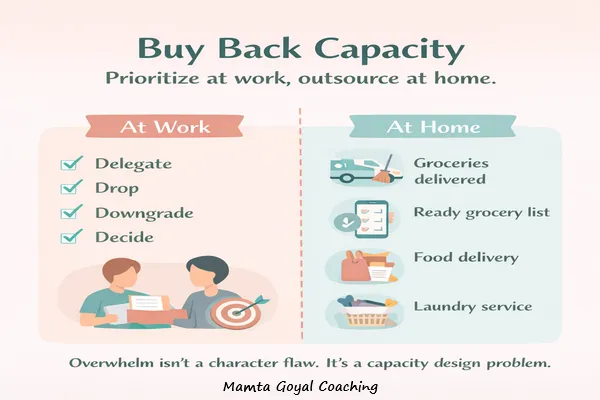
Part 1: At Work — Prioritize + Use the 4Ds
When someone is overwhelmed at work, I don’t start with “do more.”
I start with:
“Let’s decide what not to do.”
That’s prioritization.
And then we apply the 4Ds:
Delegate
Drop
Downgrade
Decide (reconfirm priorities)
It’s about right ownership and right scope.
1) Delegate: share ownership intentionally
Delegation gets a bad reputation because people confuse it with dumping.
Dumping is: “Here, take this.”
Delegation is: “This is yours, with clarity and support.”
Healthy delegation includes:
clear outcome
timeline
constraints
decision rights (autonomy)
and a check-in plan
Example (simple script):
“Can you own the first draft of this? My goal is a workable version by Thursday. Use last quarter’s template. Ping me if you hit a blocker; otherwise I’ll review on Wednesday.”
Delegation is a capacity tool because it:
distributes load
develops others
and reduces bottlenecks
2) Drop: stop low-impact work (with alignment)
Dropping work is a leadership skill.
If you never stop doing things, your to-do list becomes a museum of guilt.
Dropping doesn’t mean being careless. It means aligning.
Example (simple script):
“I’m at capacity. If we keep this task, something else must move. Which one do you want to deprioritize?”
This is how you lead upward without drama.
3) Downgrade: reduce scope (“good enough for now”)
Overwhelm often comes from perfection scope.
Not perfection as a personality.
Perfection as an unspoken standard.
Downgrading scope sounds like:
“Let’s do v1 this week, not the full rollout.”
“Let’s ship the core flow, not every edge case.”
“Let’s send a 1-page summary, not a 10-page deck.”
Downgrade is not lowering standards.
It’s matching effort to impact today.
4) Decide: reconfirm priority before you suffer
This is the most overlooked lever.
People assume priorities are clear because someone said, “This is important.”
But teams drown when everything is important.
Example (simple script):
“Given our current commitments, I can do A or B this week. Which one has the bigger impact?”
When you ask that question, you’re not being difficult.
You’re being operational.
A practical prioritization tool: urgent vs important
If your clients need a simple tool, the Eisenhower Matrix works.
It helps people sort tasks by:
Urgent (time pressure)
Important (real impact)
Asana has a clear guide on how to use it day-to-day.
Even if you don’t teach the matrix formally, the thinking is powerful:
“Important is not the same as urgent.”
And most overwhelm comes from treating everything as both.
Part 2: At Home — Outsource, Automate, Simplify (to reduce decision fatigue)
Now let’s talk about home.
This is where I want your wording to be very clear and I love your instinct/feedback here:
At work, we delegate/drop/downgrade/decide.
At home, we share responsibilities but we also “outsource personal tasks” to reduce overwhelm.
Because home tasks are often not about skill.
They are about:
time
repetition
and decision fatigue
And outsourcing personal tasks is not about “making someone else do horrible chores.”
It’s about using services, tools, and systems so you can be a better human.
Here are examples you shared (and they’re gold because they’re real):
Outsource 1: groceries delivered
This removes:
the trip
the navigation
the impulse buys
and often the “what did I forget?” loop
Outsource 2: use the store’s ready list makers
This is an underrated hack.
It reduces:
meal planning friction
“what should I buy?” decisions
and repeat mental effort
Outsource 3: ready cooked food delivery a few times a week
Not every day. Not forever.
But sometimes “good enough dinner” is the best decision.
Especially during:
intense work seasons
family needs
travel weeks
health recovery
or caregiving phases
Outsource 4: laundry service when needed
Laundry is not only laundry.
Laundry is:
sorting
remembering
washing
drying
folding
putting away
and feeling behind
A service buys back both time and mental load.
And there’s no moral trophy for suffering through it.
The “Time ROI” question (without guilt)
Here’s the question that makes this practical:
What is your time worth and what do you gain by doing this yourself?
This isn’t only about money.
It’s also about:
better sleep
more patience
fewer arguments
more presence with family
more energy for health
more focus for deep work
Sometimes outsourcing a task is the cheapest way to buy back:
peace
patience
and performance
Real-world example: “I’m drowning” → “I have options”
Here’s a composite example (based on what I hear often):
A new manager is leading a project, onboarding two team members, and dealing with constant Slack pings.
At home, they’re trying to eat healthy, keep the house in order, and help kids with school.
They feel behind everywhere.
We apply the reframe:
Work
Drop: weekly status deck becomes a one-page email
Downgrade: quarterly roadmap becomes a 30-minute outline, not a polished document
Delegate: senior team member owns meeting notes + action items
Decide: manager asks leader, “Top 2 outcomes for this month?”
Home
groceries delivered
store list maker used every Sunday
food delivery Tuesday and Thursday
laundry service during the launch week
Result?
They didn’t “get more disciplined.”
They reduced the decision stack and bought back capacity.
And that’s what made them feel like a leader again.
A question for you
If you could buy back 3–5 hours per week, where would you spend it?
More sleep?
More exercise?
More family time?
Less stress?
More deep work?
And what’s one small change you’ll try this week:
Drop/downgrade something at work, or
Outsource one personal task at home?