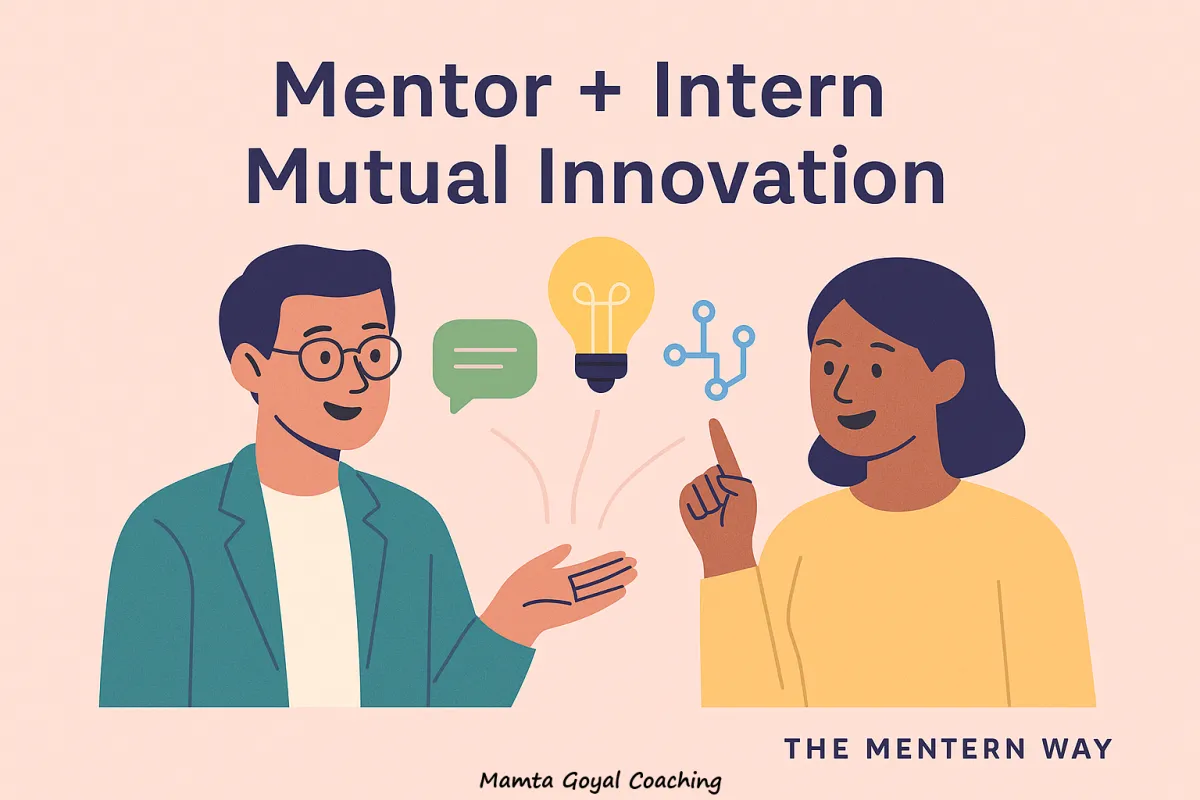
💡 From Buddy System to Mentern Magic: How Every Company Can Thrive in the Age of AI — One Mentern at a Time
💡 From Buddy System to Mentern Magic: How Every Company Can Thrive in the Age of AI - One Mentern at a Time
The familiar start: the “buddy system” that shaped us
Remember your first day at work — that swirl of excitement and quiet panic?
You didn’t know who to ask, how to file expenses, or whether “casual Fridays” meant jeans or khakis.
Then someone — your buddy — appeared. They helped you find your footing, shared what wasn’t in the handbook, and made you feel like you belonged.
That simple human connection often determined whether your first month felt manageable or miserable.
Now, as AI tools reshape nearly every role — from marketing to logistics to design — that old buddy system deserves an upgrade.
Welcome to the Mentern model — where experience meets curiosity, and wisdom meets technology.
🌱 What exactly is a “Mentern”?
The term “Mentern” was coined by Chip Conley, the hospitality entrepreneur turned modern elder, to describe a dual role — someone who mentors and interns at the same time.
He observed that in today’s workplaces, no one holds all the knowledge.
A senior leader may understand strategy and customer needs, while a younger colleague may master the latest AI or automation tools.
The power comes when they learn from each other.
A mentor offers judgment, context, and organizational insight.
An intern or junior engineer brings fresh tools, diverse perspectives, and data-driven approaches.
It’s not one-way teaching — it’s a cycle of mutual growth.

🤖 Why this matters now — for every company adopting AI
AI isn’t just transforming tech firms — it’s reshaping every business.
From HR to healthcare, from finance to supply chains, teams everywhere are learning to use AI responsibly and creatively.
And with that transformation comes uncertainty:
“Am I keeping up?”
“Is my experience still relevant?”
“What if I make a mistake with this new tool?”
A Mentern pairing addresses all three.
For newer team members, it reduces fear and builds confidence by pairing them with someone who understands the broader picture.
For experienced mentors, it rekindles curiosity and ensures they stay connected to emerging tools and trends.
For organisations, it creates an innovation loop — where knowledge flows both ways and learning becomes contagious.
Forward-thinking companies are already practicing this.
At Adobe Research, interns and mentors collaborate on AI ethics and bias projects, blending creativity with accountability.
The Allen Institute for AI (AI2) pairs every intern with a mentor from day one to co-develop real-world solutions.
The Vector Institute for AI in Toronto extends this to applied AI internships, where mentors guide both technical and professional growth.
Even outside of tech, the principle applies. A retail analytics team, a logistics startup, or a financial operations group can all build mentern pairings that bridge generations, tools, and perspectives.
When learning becomes shared, innovation becomes natural.
💬 My story: from guided to guiding
Early in my career, my “buddy” helped me navigate not just processes, but the unspoken parts of culture — how to communicate, when to pause, and what mattered most. It built my confidence.
Years later, when I became the mentor, my interns and junior engineers taught me new testing frameworks, data visualization methods, and automation tools.
Their curiosity kept me sharp.
Leadership isn’t about knowing more, it’s about creating space where learning flows both ways.
That’s the essence of the Mentern model.
📊 What research tells us
Recent studies show what many of us already feel: structured mentorship programs create measurable benefits for both people and organizations.
1️⃣ STEM Education Journal (2024)
Internships with engaged mentors led to stronger learning outcomes and smoother integration into teams. The mentor’s competence directly influenced the intern’s success.
2️⃣ Mentor Collective (2023)
Students and interns with mentors were 2.2× more likely to feel confident in their skills and 45% more likely to pursue career development opportunities.
3️⃣ Atelier Study, Stanford (2016)
Pairs of mentors and interns collaborating on real projects maintained forward progress and built best practices faster than interns working alone.
4️⃣ PMI Global Services (2023)
Pairing mentors and interns through their Thurgood Marshall College Fund program accelerated professional growth, improved retention, and deepened diversity.
5️⃣ Randstad (2023)
Embedding mentoring into onboarding reduced turnover by 49% — proving that connection drives both engagement and performance.
Across studies, one theme is constant: mentorship isn’t a perk; it’s infrastructure for innovation.
🧠 The AI-era learning challenge
The speed of AI adoption has outpaced traditional onboarding.
A junior analyst might know the latest GPT integration tools, but not how to interpret model bias.
A seasoned leader might understand strategic risk but feel unsure using a prompt library or data assistant.
This gap creates learning anxiety — the quiet fear of being left behind.
Mentern pairings bridge that gap.
The mentor provides context and ethical judgment; the junior brings energy and experimentation.
Together, they turn anxiety into learning — and learning into innovation.
⚙️ The startup advantage
💡 And if you’re a startup? Even better.
Startups live in constant change. The mentern approach helps turn that chaos into culture.
It builds psychological safety, especially for early hires learning rapidly evolving tools.
It keeps experience relevant, preventing burnout for senior leaders.
It transfers knowledge before turnover or scaling dilutes it.
Imagine a three-person founding team where each member mentors a new hire — and learns from them in return.
That’s how culture compounds.
🌈 Diversity, belonging, and reverse learning
Mentern systems also strengthen inclusion.
They encourage reciprocity — everyone becomes both learner and teacher.
At Avison Young, structured mentorship programs helped underrepresented employees access leadership opportunities while mentors gained empathy and fresh insights.
And a 2023 study on mentorship dynamics found that cross-difference pairings (across age, background, or discipline) produced more innovation than same-profile pairs.
Diversity fuels creativity — and mentern structures give it room to grow.
🌟 How to Make It Real
Start simple: pair people, set goals, share learnings.
Stay curious: let experience meet experimentation.
That’s the Mentern way — not a program, a practice.
When mentoring becomes a habit, innovation follows naturally.
It’s how teams turn anxiety into confidence and curiosity into progress.
🧩 Barriers and how to overcome them

Small adjustments can make a big difference.
📈 The organizational payoff
When done right, mentern systems deliver tangible value across dimensions:

Menterns bring balance — speed and wisdom, experimentation and accountability.
🌍 The future of learning at work
AI isn’t replacing human learning — it’s accelerating the need for it.
The Mentern model helps organizations keep humanity and innovation in sync.
It’s how companies using AI can stay agile without losing their sense of connection.
How experienced professionals can stay relevant while nurturing the next generation.
And how everyday leaders can make learning a shared act, not a solitary race.
Whether you’re building AI or learning to use it, one truth holds:
Innovation doesn’t just come from new tools — it comes from new relationships.